Why Connected Regions Win
Great experiences alone aren’t enough. This blog explores why connected regions consistently outperform fragmented ones, and how visibility, coordination, and shared pathways drive stronger tourism.
One of the more common patterns I see in tourism is regions trying to solve performance challenges with more marketing. More campaigns, more ads, more content. It’s a logical response, but it rarely addresses the underlying issue.
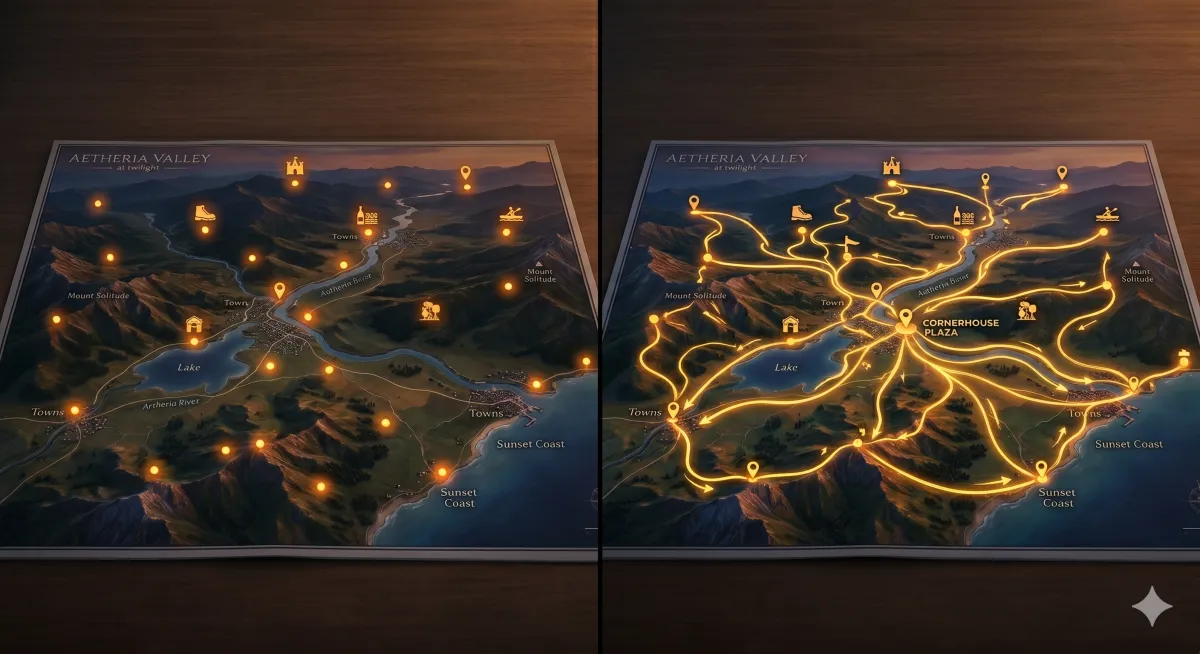
Most regions don’t struggle because they lack great experiences. In fact, it’s usually the opposite. There are incredible operators, unique activities, strong local businesses, and genuinely memorable places throughout the region. The ingredients are there. What’s often missing is the structure that ties them together into something people can actually move through with ease.
Visitors don’t experience regions as a list of options. They experience them as a journey. They’re thinking about how to spend their time, how one experience leads into the next, and how a day or weekend comes together without too much effort. When that pathway isn’t clear, people default to what’s obvious. They visit the headline attraction, spend time in the most visible areas, and miss a significant portion of what the region actually offers.
That’s where disconnection shows up. Operators are doing good work, but independently. Communities are promoting themselves, but not always in alignment with what sits nearby. Events are happening, but not always tied into a broader rhythm. Strong individual efforts don’t always translate into a strong collective experience.
Adding more marketing into that environment amplifies what’s already there. It brings more attention, but it doesn’t improve how people move once they arrive. What shifts performance is connection.
When experiences are linked in a way that reflects how people explore, things change. Visitors stay longer because it’s easier to see what else is worth doing. They spend more because they engage with more businesses. More operators benefit as demand spreads across the region instead of concentrating in a few places.
This is one of the biggest opportunities in tourism right now. Regions are rich in experience, but often thin in coordination.
People don’t travel through a disconnected list of options. They move through experiences that feel like they belong together.
Connected regions win.
Ready to support the sector that supports us all?
#GetRoaming and let’s build a more connected, resilient, and thriving Canada, one traveller, one town, one story at a time.
Yours in tourism, innovation and startups,

Founder and CEO, Roamlii